Showing posts with label 5280. Show all posts

Saturday, June 11, 2022

Escape from Alcatraz - Swim, Bike and Run like you stole something!


Escape from Alcatraz is a triathlon that has been on my bucket list for over 20 years.  The legendary island prison held the most dangerous criminals including Al Capone, "Machine Gun" Kelly and "Whitey" Bulgar. It was deemed to be impossible to escape from - until 3 men escaped in 1962.  No one ever confirmed that they were successful, but the legend goes that they lived out the remainder of their lives on the lamb.  

This triathlon is also legendary.  It started in 1981 as Sn Francisco's answer to the "Ironman" then staged in Honolulu, Hawaii.  Like all endurance races, this one is an extremely challenging physical endeavor designed to see how far the human spirit can be pushed.  

A boat ferries us out to Alcatraz Island in San Francisco Bay.  We jump off the boat and swim back to shore.  The SF Bay is known for cold and rough water, currents, wind, sharks, etc.  The swim is followed by an 18 mile bike through the Presidio, Golden Gate Park, Land's End and the Golden Gate Bridge, with the bike to run transition at Marina Green.  Then the race continues with an eight mile run on pavement, sand, mud, crushed gravel and asphalt.  Both the bike and the run have steep technical climbs/descents which add to the allure of this race.  


The view of Alcatraz Island in the background


I am 3 weeks post Covid and 4 weeks post Ironman St. George.  I haven't worked out much due to lingering fatigue probably from both the Ironman and Covid.  Unfortunately, I didn't finish Ironman St. George. It was my first DNF.  In the back of my mind, I really wanted to finish the Alcatraz race and not make a habit of DNF-ing.   

I knew I wasn't in tip-top shape, but Esacpe from Alcatraz is a much shorter distance race than I usually do.   I should be able to will myself to the finish line even if my body isn't ready. And, as always, I wanted this to be a fun experience.  I have dreamed of doing this race for over 20 years and I was finally picked from the lottery entry process.  

My mindset going into the event was "I'm going to have a smile on my face no matter what."  I finally get to do this iconic race. 

I arrived in San Francisco Friday night around 1:30 am.  I was supposed to do the Aqua-thon race on Saturday morning. The Aqua-thon was a 0.75 mile swim followed by a 5K run.  I signed up for it because I wanted to do a formal "practice' swim in the SF Bay.  

My alarm went off at 5am and I immediately said nope, not today!  Not enough sleep,  still suffering from post Covid fatigue (3 weeks).  I didn't want to waste my best efforts on a practice event.  

I slept a few more hours.  When I awoke, I put my bike together and rode for about 30 minutes around Fisherman's Warf, Marina Green and the Presidio.  I went to the race village to check in. The lines were immensely long.  I patiently waited in line listening to my fellow participants.  Many people were doing their first triathlon ever.  Brave move! There was a lot of nervous energy and small talk.  

There were the "experts" telling the newbies all the things that they need to do.  I put on my headphones and tuned them out.  I am happy to share my experiences with anyone who asks. No one was asking, and I had nothing of value to share.  

As I waited in line for 45 min or so, my brain drifted into fear mode. This event has about 2,000 people participating in it. The same number of participants as some of the more popular Ironman races.  However an Ironman race is spread out over 140.6 miles.  This race is only spread out over 28 miles. 
The sheer density of people on the course frightens me. 
 
The bike ride is a very technical course with a lot of steep up- and downhills with tight turns.  Plus it is calling for rain on race day. Add in the inexperience of the several triathlon newbies, there is a high potential for disaster.  I prayed a silent prayer that no one gets hurt- especially me!

I get to the front of the line only to find out that since I signed up for both the "Aquathon" and the full "Escape" race, my registration is in the VIP area.

"Alright alright alllllrighhhht!"  I make my way over to the VIP area where I find my race packet and my t-shirts for both races.  Because I am a VIP, I had a personal valet to answer all my questions. These questions would have been easily answered had I actually read the race athlete guide like I was instructed to from the dozen or so emails they sent out.  

Live and learn...I made a mental note to read the athlete guide over lunch.  Better late than never!

I contemplated whether I should drop off my bicycle at this moment or ride it to the race start in the morning.  Rain was predicted overnight as well as throughout the race tomorrow.  I opted to drop it off  now and be done with it.  One less thing to think about in the morning.  Rain or no rain, it was going to get wet regardless. 

Obligatory "Bike in Transition Area" Picture

I then got lunch - legendary San Francisco dim sum in Chinatown (yummy!).   While eating lunch, I pulled out my computer to read the athlete guide.  Lot's of valuable information including a mandatory pre-race meeting this afternoon.  I was planning to do a practice swim after lunch digested for a few hours.  I scrapped that idea and went to the meeting.  

The race director gave some very important info regarding the swim. There are two distinct current channels so my swim trajectory is super important.  There are 20,000,000 gallons of water exiting the SF bay per second running through these currents.  He told us that if we don't get through the channels, we will miss the swim exit and could end up in Hawaii.  

So I spent the rest of the day/night researching swim strategies for this race on facebook and youtube.  I got my plan together and went to sleep. 

I woke up at 3 am.  My gear was laid out for one final mental visualization of my needs for the race.  I went though everything I would need for the swim, bike and run portions and put them into my bag.  Then I threw in a bunch of extra things for "just in case" situations.  

I shared an Uber with a fellow racer I met in the lobby to the transition area.  It was was raining fairly hard.  I usually like to set up my transition area with everything laid out for ease of accessibility in the order I will need them.  Because of the rain, everything stayed in the bag.  Our bikes were already drenched!  

I learned a while back that endurance events are opportunities to practice acceptance.  I try to train/plan to the best of my ability.  Unexpected things always come up.  My mindset must be open to these so I can troubleshoot in the moment.  If I'm rigid, my attitude will contribute to my demise.   

"Some people dance in the rain, others just get wet."   Today, I choose to dance in the rain.  

I make quick friends with my transition area mates. We all walk over to the shuttles that take us to the ferry.  All 2000 of us get on the boat and it takes about an hour to bring us into the proper coordinates.  

There is a lot of nervous energy on board.  I chose not to participate in it. Until...some of the seasoned Escapees see that the boat isn't in the proper position.  We all go to the windows to witness the change of plans.  

The race director makes an announcement over the PA that a dense fog has moved in. We will not be able to sight the landmarks.  They moved the boat closer to shore and told us to swim towards the west.  This would bypass the first current channel making for an easier and safer swim.

I put on my wetsuit, my thermal swim cap,  and layered my race cap over.  I positioned my goggles over my eyes and prepared for the leap into the 55 degree water.  

To prepare for the shock, I have been taking cold showers for several months. Both of my races this spring had cold water swims in the mid to high 50's.   

Last year, I jumped into 59 degree water at St. George Ironman 70.3. My heart rate
spiked and my oxygen demand went up from the cold.  Plus, as I started exerting myself with swimming, my heartrate went up even higher.  I went anaerobic and had to hang onto several lifeboats positioned along the swim course while I tried to catch my breath.  

As I got into position, I watched my fellow racers jump in and get out of the way quickly. One of my fears was getting jumped on by my fellow racers as I entered the water.  I jumped as far forward as I could to avoid this from happening. (Other fears include shark, killer whale attack, drowning, etc).  

I jumped in feet first.  When I surfaced, I swam as quickly away from the boat as I could.  I escaped Alcatraz and no one landed on me!  Now I need to get through the swim.  

That isn't me, but it was the closest picture I could find...
Note the fog toward the shore!

It is easy for my mind to drift during the swim.  It is impossible to talk to other people during this leg of the race - so it is just me and my thoughts.  Mindset is everything on race day.  I do a lot of mental training in addition to the physical training.  One of  the mantras that I use often is "Race the mile I'm in."  This reminds me to stay focused and to enjoy every moment. 
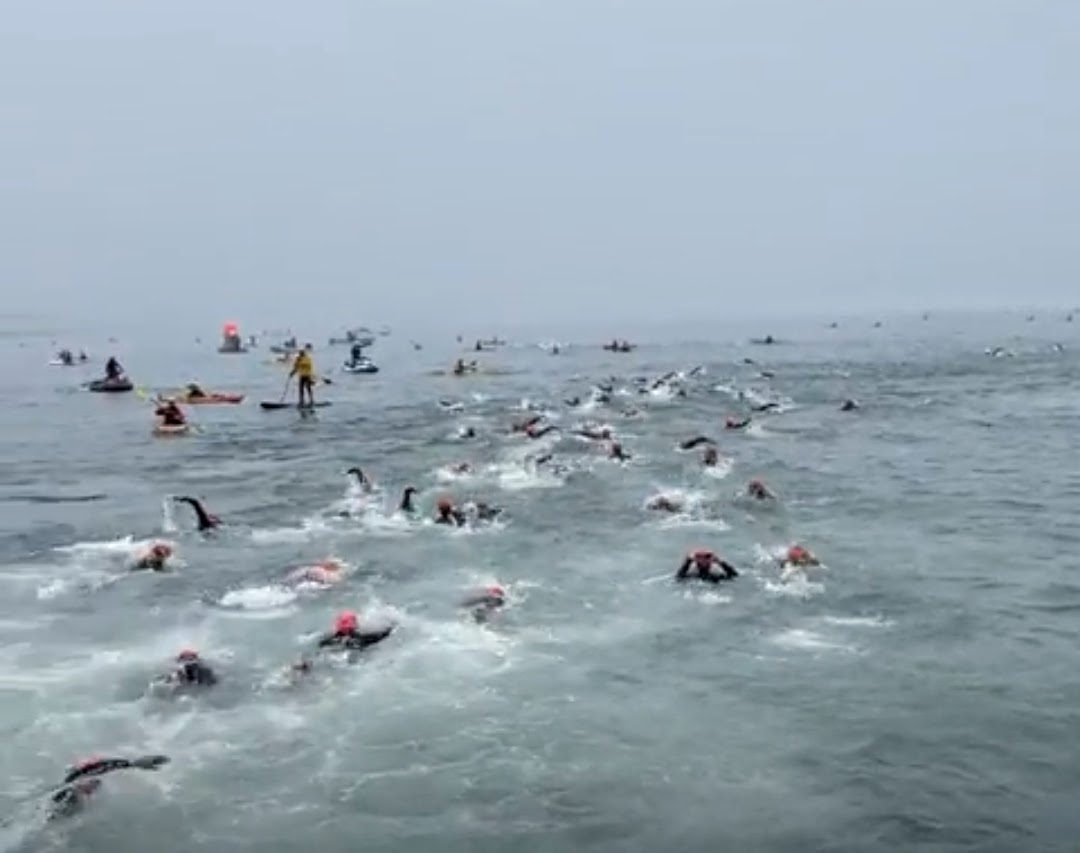
In the current channel going towards shore.  Note the fog completely obliterating the view of shore


I am in a tight group of swimmers.  I tried to draft off of a few in front of me, but they all kept bumping into each other and stopping forcing me to swim into them.  I moved out to the right (further out from shore) and found some swim space.  About 10 minutes later, I realized that I was all alone. 

"I'm either in first place or last..."  I thought to myself.  I looked over towards shore and didn't really see anyone.  Suddenly, I felt a tapping on my shoulder.  I look up and it is a safety kayaker tapping me with his paddle blade.  I stop to see what he wants.  He told me with a great big smile on his face, "You are swimming really strong, but you are swimming towards Hawaii!"  He points me towards the shore.  I laugh and redirect my trajectory. 

I quickly found that I had to swim across the current to get back on course.  So I dig in and get across it within a few minutes.  I used a sprint effort and I was happily able to recover to a manageable heart rate fairly quickly.  I got back in with a better group to work with.  

When I swim, I naturally breath towards the left (facing the shore in this case).  As we got closer to the shore, I can see how fast the current is taking us.   It truly felt like I was swimming downhill. The rest of the swim was fast and smooth. 

Total Swim Time:  38:40 (1:22min/100yd)  Total Yards: 2,841 (1.6 miles)

Swim Stats from my Garmin Watch


I escaped the water and let the wetsuit strippers help me out of my wetsuit.  I had a pair of shoes at the swim exit but I opted not to use them.  I was wearing swim booties to protect my feet from the cold water.  I decided to keep those on for the 0.8 mile run to the the transition area.  I got rid of my "sea legs" pretty quickly and easily ran to T1.  It was raining fairly hard but the air temperature was a perfect 65 degrees.  

About half the bikes were gone already from my rack in the transition area.  Which meant I was in the middle of the pack.  I was extremely happy as I was still recovering from the exhaustion from covid three weeks prior.  

My bag was soaked on the outside, but dry inside.  I put on my helmet, socks, cycling shoes and sunglasses.  I was tempted to not bring my glasses as they don't do well in wet conditions. I have a prescription insert and when it is raining, water gets between the insert and the sunglasses making it impossible to see through. I decided to wear them anyway. It definitely hindered my field of view as I ended up wearing them down my nose a bit. 

The first 1.5 miles were cold rainy and the road was flat.  The race director said "to ride like you stole something" in this part of the course to get warm.  
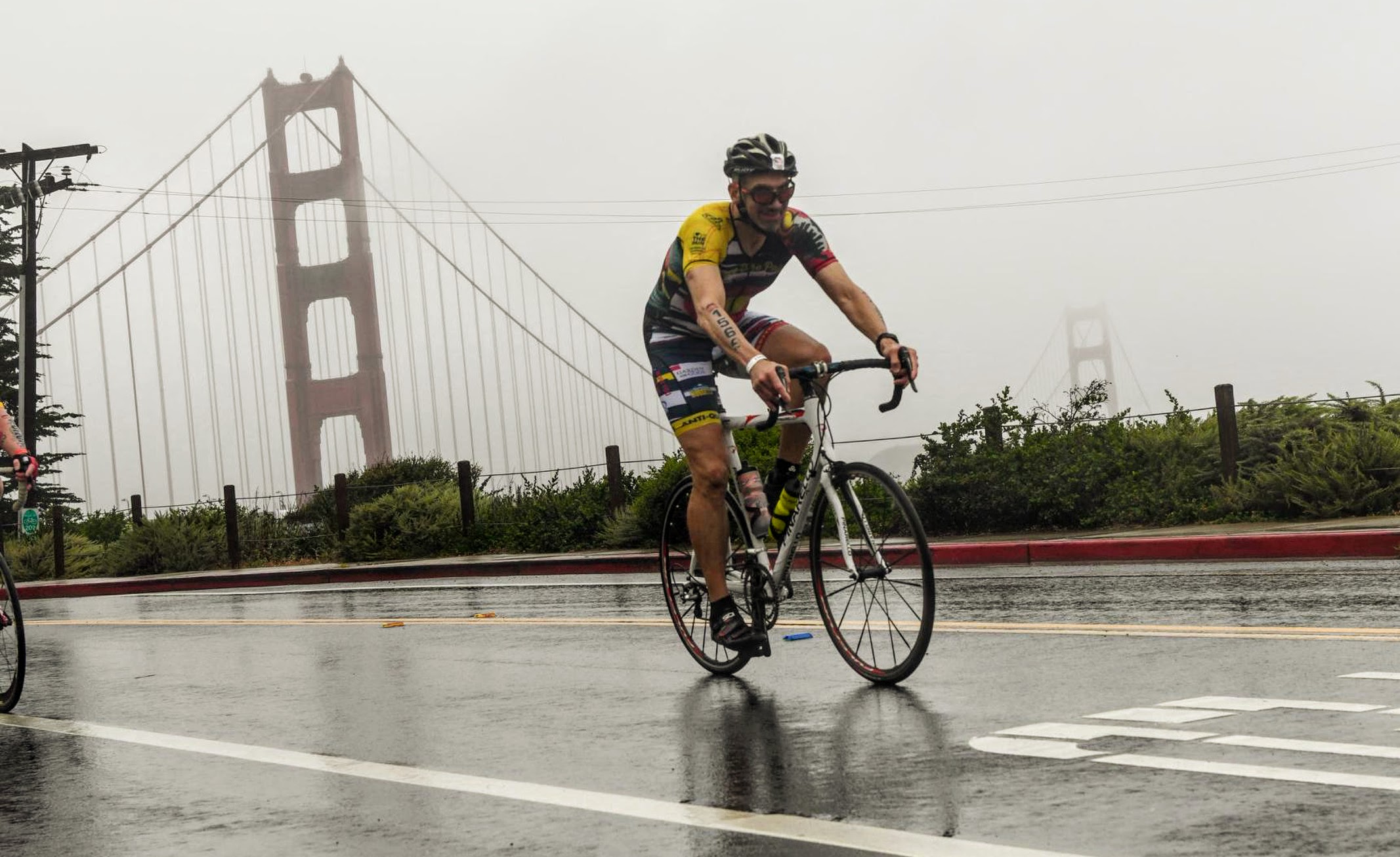

San Francisco has legendary steep hills.  The course definitely didn't disappoint and showcased many of them.  It was a very technical bike course with steep ups and downs, several sharp turns and rough roads.  I am happy that I brought my road bike for this ride.  My time trial bike isn't great for climbing and tight turns due to the frame geometry.  My road bike is really nimble and climbs like a dream. 
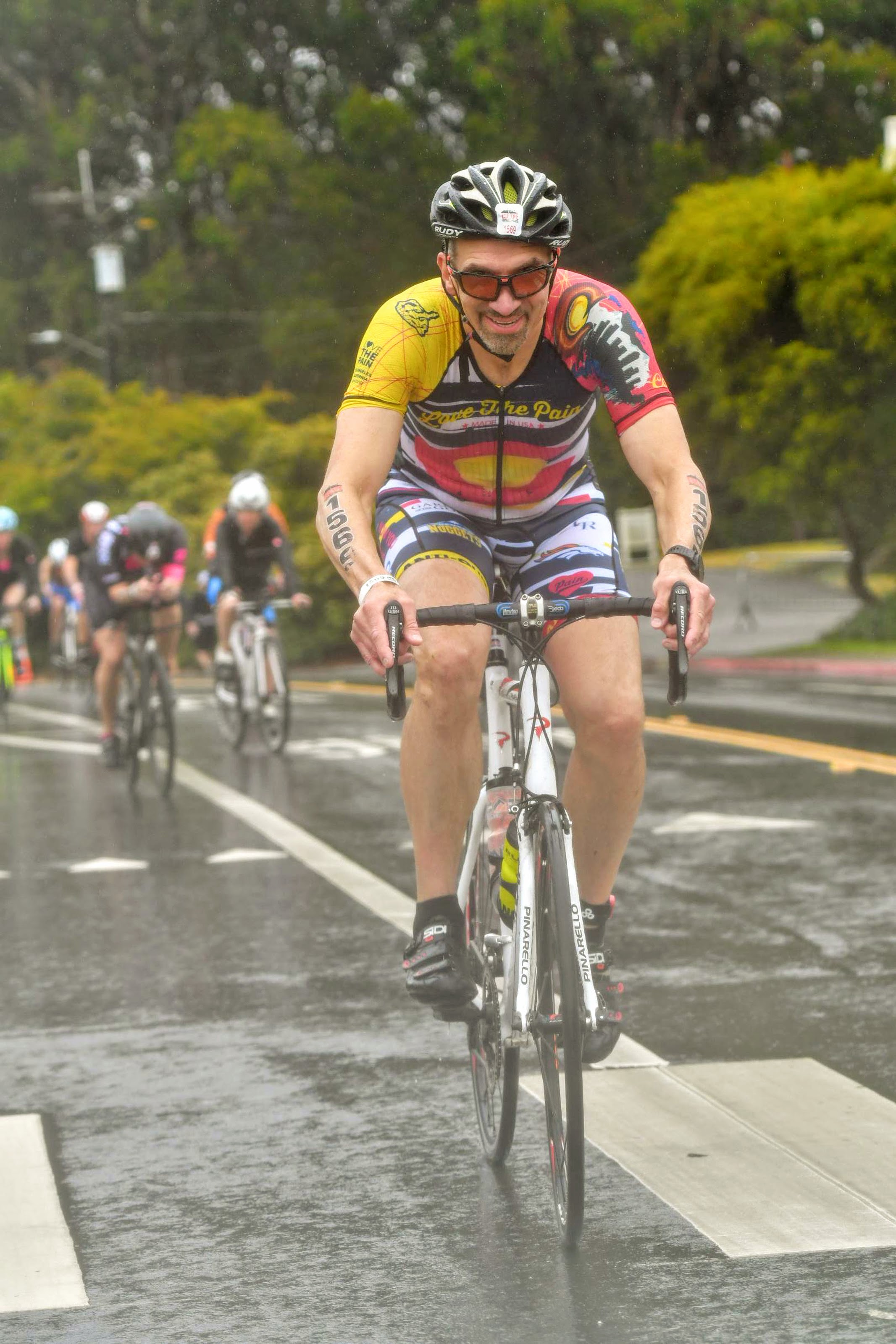


The bike course, as I expected, was really crowded.  Combine this fact with the rain and the technical nature of the route, it was fairly dangerous.  I saw several people wipe out and take others out with them.  There were lots of people with flat tires.  I even saw someone break their chain on a steep climb.  I was very conservative on my ride due to this.  Maybe if the conditions were a little better, I would have taken more chances.  The views were obscured by the rain clouds which was a bummer.


As I went through the Presidio, I knew it was a flat ride into transition.  But again due to the amount of riders on the course, I took it easy, happy to have made it though this unscathed.  


Bike stats and elevation profile from my Garmin watch


Transition 2 - still raining.  Changed into my running shoes, grabbed my run visor and a gel and got moving.  Again, I contemplated leaving my sunglasses in the transition area.  Hopeful that it would stop raining, I chose to wear them.  For most of the run, they were on top of my visor as I couldn't see out of them due to the rain.   

The run started out flat which was nice as I found my running rhythm.  I loved the run course - it almost could be classified as a trail run.  The running surface varied from pavement, crushed gravel, mud, sand and asphalt.  Like the bike course, it had a lot of short and steep climbs/descents.  I was able to run most of the course.  

Focus!

The only section I power hiked was though the deep sand at Baker Beach, then the famous "sand ladder" which rose from the beach to just below the Golden Gate Bridge.  (300 ft. +/- climb)  

Exiting the sand ladder climb


I ran the up-hills, and really tried to push the pace on the downhills.  I  have been running long course races the past few years where I am intentional on conserving my energy to ensure that I will finish.  This run was only 8 miles so I didn't hold back.  If only I was in better shape! 

I met many people on the run and had many conversations along the way to pass the time.  I tried to keep the mood light and cracked many jokes with the people around me.  I wore my Colorado triathlon kit with my name on the back.  Dozens of people yelled "Kessler" at me as I passed them or they passed me.  

There was a paved downhill section with some tight turns.  I decided to pass a group of 3 runners taking one of the turns wide.  As I passed them, a photographer sat there waiting to take our picture.  Not knowing this, I ruined their opportunity for the best picture on the course.  I apologized to them and laughed.  Now that I see these picture, they turned out to be my favorites!
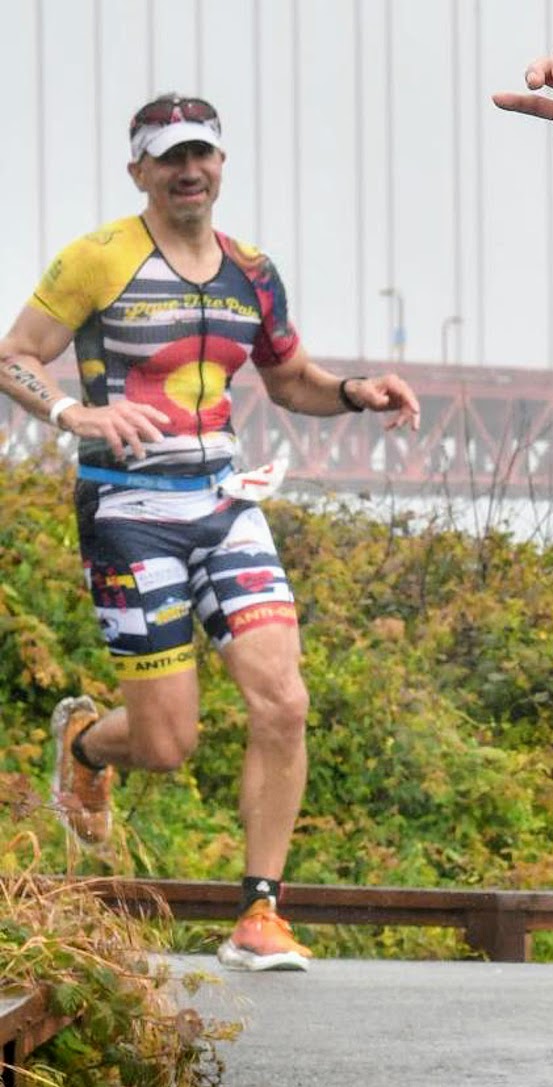
The "Pass"

Embarrassed smile as I knew right then that I ruined these runners' picture


The finish was on a grassy section.  I always get emotional as I cross the finish line.  This was no exception.  I was extremely grateful to complete this race.  So many thoughts were going through my brain:  My recent DNF followed by Covid;  Grateful to have had a relatively mild case compared to how Covid was 2 years ago; My lack of fitness due to the aftermath of Covid;  Getting through a challenging race on a challenging weather day; Completing this race after 20+ years of trying to get in; And finally recognizing that without my sobriety, this would never even be an option.

Almost home!


Elated finish!


Run data form my Garmin Watch


After the race, I had my medal engraved with my times, and ate a lot of food in the finish area.  I collected my bike and my drop bags and rode my wet bike back to the hotel.  


Thank you to my coach Charley Perez (CP Coaching); my family, friends and colleagues; My training partner Shane Mahoney for pushing me on my runs; And to the universe for giving me so many gifts in my life!

#theadventurecontinues #anythingispossible #sober #ADAtrustee #UltrAspire #InspiredbyAthletes #RockyMountainTriathlonClub

Sunday, April 17, 2022

The Most Influential Person in the History of Dentistry - was not a dentist!

I found out about this in the most surprising way.  I was reading the book The Power of Habit, by Charles Duhigg and I was introduced to Claude Hopkins.  He is considered the most influential man in dentistry.  Ironically, he was a marketer, not a dentist.  He was considered one of the most influential marketing experts of his time as well.

How was he the most influential person in the history of dentistry?  His marketing campaign helped to create the habit of daily toothbrushing.

In the early 1900's, tooth decay was rampant in America.  It was so bad that it had become an issue of national security.  There were so many WWI recruits with oral infections that they were hampered in pain and could not perform on the battlefield.

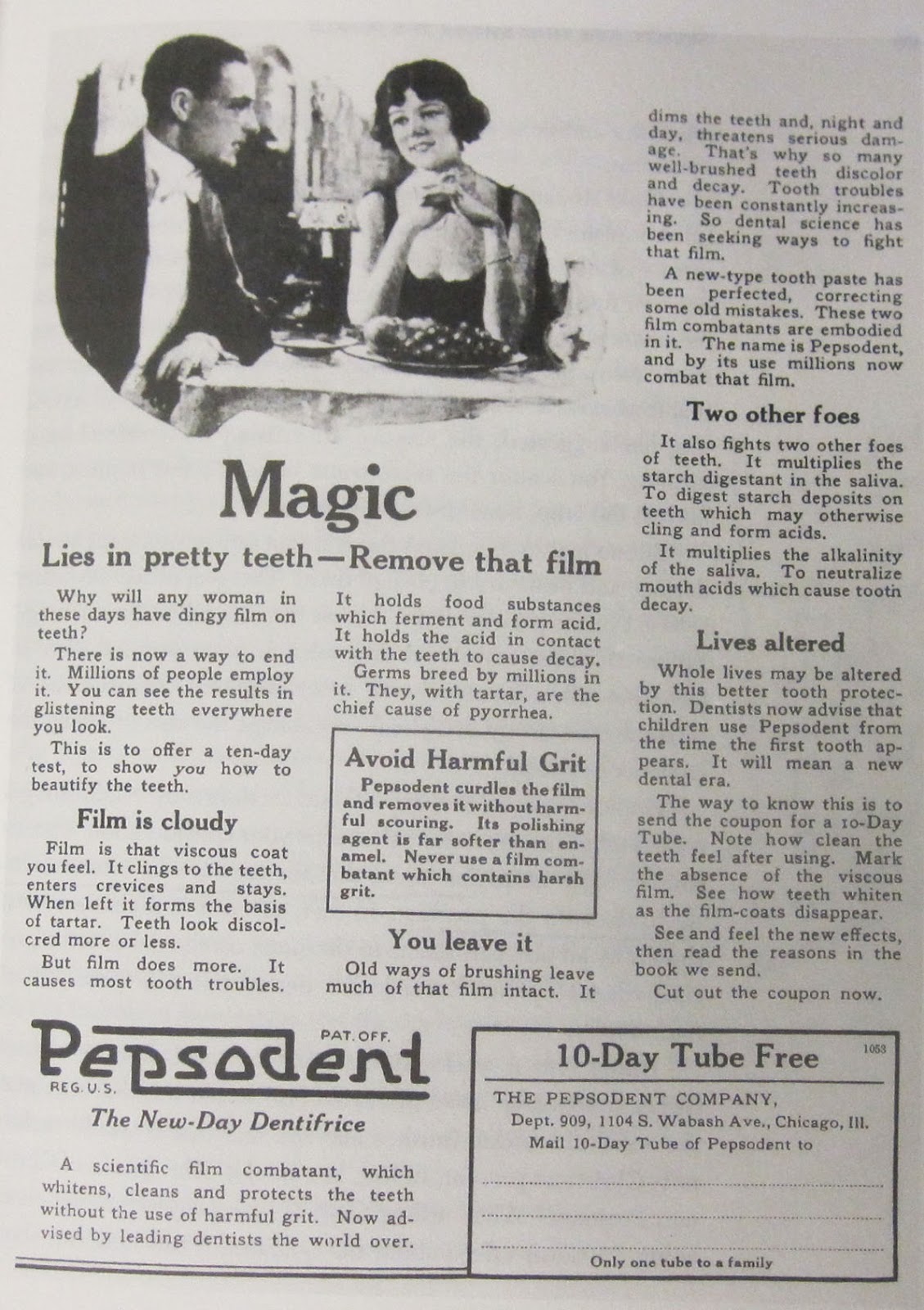
Claude Hopkins was approached by an old friend about a new dentifrice (toothpaste) called Pepsodent.  At the time, tooth powders were peddled door to door by traveling salesmen.  Hopkins quickly declined the offer to promote this toothpaste.  It was a losing battle as less than 7% of the population in the United States had an actual toothbrush in their medicine cabinets.

It was not part of our daily routine at the time.  Why would people use toothpaste, if they didn't even use a toothbrush?

The Pepsodent people, quite confident in their product, were persistent with Hopkins and eventually he agreed to take on the marketing campaign.

As Hopkins dove into the (boring) dental scientific literature of the time, he stumbled upon a description of the "mucinous plaque" that forms on teeth.  This film, he found out was the root of all dental troubles.  This is where the bacteria was that caused the tooth decay and gum disease.

Ironically, it was easily removed through normal toothbrushing without the use of any toothpaste. He ignored this fact and exploited the horrible "film" that destroyed teeth and ruined smiles.


Figure 1 - Pepsodent ad from 1929 describing the call to action 

Actual Pepsodent Advertisements

His marketing campaign was brilliant.  He created a cue, "Rub your tongue across your teeth and you will feel this film."  He then went on to say that this film must be removed each day.

He also appealed to the self esteem of the population - He implied that having a nice smile is a crucial part in being beautiful and attractive.

By creating a daily cue (rub tongue across teeth), encouraging repetition (the film must be removed daily) and establishing a reward (beautiful smile) - he helped create a national habit of daily oral hygiene using toothbrushes and pepsodent.

Through this marketing campaign, the people in the US that had toothbrushes and actually used them soared to 65% within 10 years.

If he was still alive, I wonder how he could create an ad campaign for flossing everyday too.

The dental profession hasn't figured out how to appeal to the emotions around flossing.  We all know the logic behind it, but to create this habit, we need to appeal to the emotional side of the communities that we serve.

On a side note, I just have to say:
clean teeth do not decay.....

Another side note that I learned at TEDMED last spring:

 More people in the world have smart phones than have toothbrushes......

Hmmmm.....


If you like this blog post, I would love to hear about it.  Please comment or share it on Facebook, LinkedIn, Twitter, etc.  

Thanks for reading!

Monday, April 4, 2022

Drawing from the Courage of Dr. Martin Luther King, Jr.

Early evening April 4

A shot rings out in a Memphis sky

Free at last

Theytook your life

They could not take your pride

U2- "Pride"

Dr. Martin Luther King was shot on this day, April 4, in 1968 as he exited his room at the Lorraine Hotel in Memphis, TN

His "I have a dream" speech inspired hope into millions in 1964, and continues to inspire generations/populations near and far today. It peacefully challenged the culture to live up to the ideals that were spelled out in our Constitution.

He was the ultimate disruptor in that turbulent period of time. His words resonated with so

Every time I visit Washington DC, a magnetic force draws me to the step where he put it all out there.

I stand on that step and contemplate the question, "What is my purpose?" It is an opportunity to reset my trajectory from autopilot to one of intention.


Living with intention is a courageous path. The path is filled with ups and downs, setbacks and victories, challenges and times of ease.

I regularly struggle with fear and faith as I trudge my path. Faithfully, I continue to move forward and gather help/supporters along the way who help me stay focused.

Churchill said, “To each, there comes in their lifetime a special moment when they are figuratively tapped on the shoulder and offered the chance to do a very special thing, unique to them and fitted to their talents."

I don't always know I'm being tapped on the shoulder to do a special thing. I set myself up every day to be ready when the tap comes. When I look back, I see that so many of my actions/accomplishments were of significance, though I may not have noticed it at the time.

Just like Dr. King, the path I'm on may not be popular. It may create strife along the way. If I know that I am being true to myself, I press forward. I am constantly checking in on my purpose.

Even though I only visit the MLK step sporatically, through mindfulness practices, I can find inspiration of equal merit anywhere I am. If I am having trouble, I just remind myself of this image~!


Tuesday, March 13, 2018

Starfish and Ripples - Musings from Guatemala dental mission trip

Recently, my wife, Dr. Gina Kessler and 15 other colleagues from Dentistry Making a Difference went to Guatemala for a dental mission trip.  We have always wanted to do something along these lines.  The opportunity presented itself so we decided to go for it.  Here are some of my musings. 

March 7, 2018 - I am in San Pedro, Guatemala on a dental mission trip with my wife, staff and several colleagues.  We are seeing people who are in extreme poverty with huge dental needs.  My comfort zone is being stretched in huge ways as I am not in my "cushy urban" office anymore.  We are in a 5 chair clinic that opened recently through the Spear “Open Wide Foundation”. 

One patient I will never forget.  Her name is Araceli. She is a beautiful 5 year old girl, dressed in a pink jacket and a traditional style dress. I haven’t treated a child this age since dental school.  I don’t know who is more nervous - her or me.

Araceli (5 y.o) looking into the clinic


In the morning, she had been outside watching us do our work from a window outside the clinic.  Her turn was in the afternoon.  She came in terrified and reserved - probably frozen by fear.  I had a translator help with the communication. I looked in her mouth and my heart sank. She had dental needs in every tooth due to rampant decay. I consulted with the staff dentist at the clinic hoping that she would say refer her to a pediatric dentist - this kid needs to go to the OR for her treatment.  There were none to be seen. The staff dentist and I consulted, it was decided to take out her five front teeth (c-g).  This was just scratching the surface of her dental needs.   

I gave her injections and pulled her teeth.  

She screamed, I cried. I fought through my own emotions and got to work as quickly as I could.  She screamed some more, I cried some more. 

When it was over she calmed down and gave me a hug, thanked me for helping her. I am not really sure if I helped her.  She is a kid that, if she was in the states, she would be brought to the operating room for her treatment. My mind was racing with questions probing the unknown.   Did I really help her?  Did I traumatize her?  How will she get the help she needs?  How will her dentition turn out?  How will her psyche be affected?  I took out 5 infected front teeth. Will her adult smile reflect the beauty of this girl as she grows into adulthood.  If her teeth are this infected, how is her overall health?


Gina, Araceli and me after her treatment.


There is so much dental disease here. There are not enough dentists in the world to fix all the decay here.  How can I possibly be making a difference?

Starfish story link - 

I have come to the conclusion that I made a difference for Araceli. I may not have been able to address all the needs in this town.  But I made a difference for her.  Our team of 5 dentists and 12 assistants/hygienists made a difference for the 100 or so patients that were seen in our clinic these past 5 days.  

Hopefully she will start to brush, floss and change her diet. I am not sure if there is clean water where she lives.  She probably doesn’t even have running water let alone indoor plumbing in in her house.  I tried to explain Araceli’s dire need for more dental work to a lady that said she was her grandmother. (She also said she was the grandmother to the several other kids that were there that day).  I am not sure if she understood - I didn’t speak Spanish, she didn’t speak English.  My recommendations were translated to her, but was it heard? 

Guatemala has what is considered extreme poverty.  The average income for a family is $300/month.  Over 25% of the population is considered illiterate.  School is mandated for 6 years, but the average is a little over 4.  There just aren’t resources for them - especially in the rural areas.  

I know that there are similar situations happening in our communities back in the states as well.  I feel that for most though, they have a chance. There is infrastructure to provide opportunities to get help.  I also know there is not enough.  

The dental future for Araceli and her family may have changed trajectory based on this experience.  I hope so. I also hope that her experience in our clinic will ripple out in ways that she will be able to contribute to the world in her own unique way. Who knows, she may become a staff dentist at a similar clinic in her community.  

We never know who we impact or how we affect someone - be it our patients, friends, colleagues, acquaintances, etc.   It could be that we get someone out of pain, fix their smile, remove infection.  It may be that a conversation that we have with our patients every single day finally sticks with someone.   We never know when someone hears something that catalyzes a much needed change in their life.  All we can do is keep doing the best we can - sharing our unique skillset to those in need.  I have had many patients come back for their six month cleaning and check up and tell me how our conversations changed the trajectory of their lives.  I feel that a smile is a window to the soul and we do everything we can to help our patient’s soul shine through. A smile can change a person’s life.  

I have come to the conclusion that we made a difference today for Araceli.  We barely scratched the surface, but we made a difference for her.  

I hope that the difference we made for her (and our patients back at home) ripples out into the world to create more positive difference.  

Starfish and ripples. 


BK

Thursday, September 15, 2016

Do you take my dental insurance? Nope and Here is Why!

Lately, I have been thinking a lot about the dental insurance industry and the public's expectations of it.  I am not a participating provider in any plans. 

Why, you ask?  Please read on.  

The definition of insurance: a practice or arrangement by which a company or government agency provides a guarantee of compensation for specified loss, damage, illness, or death in return for payment of a premium.

The key phrase with this definition is: "guarantee of compensation".  


Some examples:

If my home burns down, gets damaged by hail, or ruined by a flood, I expect that my homeowner's insurance will compensate me to rebuild my house and help to replace my belongings. Of course, after I pay my deductible.  I don't expect my homeowner's insurance to pay for my replacing air filters for the heater. I don't expect them to pay for caulking of my shower on a regular basis. I don't expect them to pay for the blowing out of my sprinklers or cleaning my air-ducts. 


If I get into a car accident, I expect that my auto insurance will compensate me to fix or replace my car and help with any injuries as a result of the accident. Again, after I pay my deductible.  I don't expect them to pay for my oil changes, my brakes, rotating of my tires or other preventative measures that I would take on a regular basis to keep the car running smoothly and safely. 


If I get sick, I expect my health insurance to cover for my medical bills after my deductible is met. I trust that my physician knows what is best specifically for the treatment of my medical problem and recommends things in my best interest.  I don't expect my plan to pay for my health club membership, healthy organic eating choices, vitamins or anything that would help me be more healthy proactively.  


Now let's look at dental insurance -


A typical dental insurance plan will pay a certain amount per year for your dental treatment in the range of $1,000-$2,500.  They pay a percentage of the procedures done and fix costs that your dentist can charge for these procedures.  In some states, they control the prices for procedures that they do not cover, but that is another story for another time. There may be a deductible to pay as well as the monthly premiums.  

Let's base these scenarios on the dental insurance model - 


If my home burns down, my insurance pays me $1,500 and I am responsible for paying everything else to rebuild my home, I am responsible for replacing my possessions lost in the fire.  There may or may not be a deductible. They may ask for a pre-estimate of the worth of my home and possessions but that but burned up in the fire and delay the payment accordingly.  Even though the maximum amount they will pay is $1,500.  Oh by the way, your deductible is $1,000... They don't care that you have been doing regular maintenance around the home on a regular basis.  They will question the use of certain pressure fire hoses to put out the fire saying that a garden hose would have been sufficient. Or they may have down-coded the use of a fire truck to a typical water pail passing line that was used in the 1,800's.   


If I get into a car accident, my insurance pays me $1,500 according to my plan, and I am responsible for the remainder of the damage, paying for any injuries, etc. Typically there is a deductible of $2  50-$1,000. I find out that they only pay for 50% to replace my tires.  They won't tell me 50% of what however.  I choose the same tires that I had on the car and they proceed to say that I was overcharged at the tire store that they recommended I go to.   I find myself questioning what benefit I am getting here as I add up my monthly premiums and the payout in my head...."Is this really worth the hassle?"


If I get sick and in the hospital, my insurance pays me my $1,500 while I am responsible for any blood work, x-rays, MRI's, surgeries, medications, ongoing therapies, etc....deductible? As an aside, I ask my physician how much each of these tests she is recommending are going to cost.  Blank stare...After an uncomfortable 60 seconds of silence I burst out, "Doc, I need to know how much this is going to cost me!"  She replies, "I don't know, I can have my office manager check what your benefits are and get back to you tomorrow"  


In any of these alternate scenarios, my financial responsibility would be catastrophic. 


Dental insurance is a misnomer.


It is not insurance.  It is a pre-paid benefit plan. It is in fact the opposite of insurance.  It covers the deductible and you cover the rest.

I think dental insurance is great for basic dentistry - cleanings, check-ups, x-rays, a filling here or there, etc.  If things get complicated with your treatment, your benefits will cover only what they cover based on the plan and nothing more.

What the benefit company isn't telling you - "We are great for basic dental care but don't expect us to be like homeowner's, auto or medical insurance.  Those insurance models cover you to prevent catastrophic loss.  We don't...Please set your expectations accordingly."

I choose to have a relationship based practice.  I take the time to get to know my patients and help them to discover and achieve their oral health goals.  Together my patients and I look at all the options with the pro's and con's of each.  Most of my patients have dental benefits and we do everything to help maximize those benefits for our patients.

As a result, I choose not to participate with these benefit plans.  I wish to have a relationship primarily with my patients.  A relationship that is not tethered by the restraints put on by an insurance company that has never met their subscribers. You are a number to them, a potential for them to pay out against their profits.  I view the relationship that I have with my patients as the most important aspect of my practice. I will only recommend treatment that is in my patient's best interest in achieving their goals for their teeth and smile.

By the way, if you don't have dental insurance, basic dentistry is fairly affordable and the cost of prevention is much cheaper than the cost of complicated dentistry caused by missing regular dental checkups!


If you like this blog post, I would love to hear about it.  Please comment or share it on Google+, Facebook, Linked in, Twitter, etc.  If you are looking for a dentist in the Denver area, we are always looking for new patients.  Please visit our website http://www.tcdodenver.com/ or like our facebook page,  https://www.facebook.com/TCDOdenver.  Or you can contact us  the old fashion way - call us at 303-321-4445.


Thanks for reading!  BK

Friday, May 1, 2015

I Try Not to Get Political - But....

"I Have a Dream" - the MLK Step at the Lincoln Memorial at sunrise
Once again, I was honored to have been chosen as part of a delegation to represent Colorado dentists and attend the Washington Leadership Conference put on by the American Dental Association. It is an opportunity for leaders in dentistry to meet with our national legislators to educate and advocate best practices and trends that we are seeing.  In a time of such flux with the delivery of healthcare, we offer perspective that hopefully will help shape health care and ensure that we can best serve our communities.

It was an interesting social and political time in the area.  A man named Freddie Gray was killed while in police custody shortly after being arrested.  Sadly, a much too common occurrence not just limited to Baltimore, but across the nation. The protests began peacefully but soon turned violent.

I was Baltimore to attend the Orioles game on Saturday evening. There was a palpable energy inside and around the stadium due to a strong police presence. At the game’s conclusion, the fans were not allowed to leave for their own safety until the riots had calmed.  

As time marched on, the riots continued. Buildings were damaged and looting ensued.  People were injured.  The National Guard was called in, and a curfew was instituted. CNN and Fox News were having a paparazzi feeding frenzy with a countdown to the mandated curfew. There were several more arrests and a public outcry….The entire situation was sad to witness.

Order was not restored quickly.  It wasn’t safe to be in the area.  The following day the Orioles game was cancelled.  Oddly, the next day’s game was played to an empty stadium.  Never before has a Major League baseball game been played in an empty stadium.

Pictures from the game which no one watched

Back in DC,  we dentists were meeting with our legislators.  Several of our legislators mentioned that they were invited to various “State”events (dinners, lunches, etc) with the President, who was hosting the Japanese Prime Minister. 

The Japanese Prime Minister (Shinzo Abe) must have been wondering about how this "free speech thingy" (1st Amendment) is working for us….I am sure that President Obama was thinking the same thing.  At a press conference to introduce the PM, POTUS took a few minutes to address the rioting. 

He recognized first that the rioters who were committing unlawful acts were not helping the situation.  They were no better than criminals and thugs taking advantage of an opportunity to be destructive. 

He then balanced his displeasure at the fact that some police officers/departments are not doing what is mandated that they do -"to protect and to serve”.  They too needed to reform and be held accountable.  

He continued to address the core issue with some of the most profound and inspiring words I ever heard him say.

"Without making any excuses for criminal activities that take place in these communities, what we also know is that if you have impoverished communities that have been stripped away of opportunity, where children are born into abject poverty, they’ve got parents often because of substance abuse problems or incarceration or lack of education themselves can’t do right by their kids, if it’s more likely that those kids end up in jail or dead that they go to college, in communities where there are no fathers who can provide guidance to the young men, communities where there’s no investment and manufacturing’s been stripped away and drugs have flooded the communitiy and the drug industry ends up being the primary employer for a whole lot of folks… In those environments, if we think that we’re just gonna send the police to do the dirty work of containing the problems that arise there without as a nation asking what we can do to change those communities, to help lift up those communities and give those kids opportunities, then we’re not going to solve this problem.

America, the land of opportunity - has no opportunities to thrive for some people. 

Without opportunity, there is no hope to dream. Frustration ensues and more riots are going to occur. 

We must return to our roots- the ideals that serve as our country’s foundation - life, liberty and the pursuit of happiness.  

We need to take back our freedom.

We must accept that to right the ship, there are no simple answers.

We all are going to need to sacrifice for the betterment of the whole.

The finger pointing needs to end now.  

We need to work together to figure out solutions that spur opportunities for everyone to contribute. Americans have always had the creativity combined with the spirit to make this happen.  

We need real solutions, not more riots…

If you like this blog post, I would love to hear about it.  Please comment or share it on Google+, Facebook, Linked in, Twitter, etc.  If you are looking for a dentist in the Denver area, we are always looking for new patients.  Please visit our website http://www.tcdodenver.com/ or like our facebook page,  https://www.facebook.com/TCDOdenver.  Or you can contact us  the old fashion way - call us at 303-321-4445.


Thanks for reading!  BK

Thursday, December 4, 2014

Who is John Galt? How Corporate Dental Offices are Disrupting the Status Quo.

Who is John Galt?
Disruptors in Dentistry
By Brett Kessler, D.D.S., CDA President


"I started my life with a single absolute
That the world was mine to shape in the image of my highest values
And never to be given up to a lesser standard, no matter how long or hard the struggle" Ayn Rand, Atlas Shrugged


Disruptors are innovators.  They are businesses that shift a mindset of how consumers think, purchase, etc. – thereby challenging established businesses.

Harvard Business School professor and disruption guru Clayton Christensen says that a disruptor displaces an existing market, industry, or technology, and produces something new and more efficient and worthwhile. It is both destructive and creative.

Some examples of disruptors are companies like Apple, Netflix, Amazon, and Uber.

I identify Apple not for the computers that it builds, but for another niche that it took over – music and listening device sales.  iPods, iPhones and iTunes have changed how we buy and listen to music. There are hardly any CD stores remaining other than those that sell used discs.  When I grew up, I would buy records.  The cover art would attract me to give new bands a listen.  I judged the band by entire albums that it recorded.  Today, we buy songs, not albums. They are instantly downloaded onto our computers.  No waiting in lines; no browsing through tedious shelves of records/CD’s.

We create playlists with the drag of a mouse.  We use auto shuffle and the “genius” feature to create our own personal radio stations. They connect to our cars, our phones, our tablets and all are stored on our computers.  CD players are becoming a thing of the past.  Music is stored on hard drives, flash drives, iPods, etc.

Netflix took how we rent movies to a new level.  For a low monthly fee, we can have unlimited movies shipped to our house – hassle free – or immediately available to view on our computer or smart TV’s through an internet connection.  Blockbuster used to charge late fees, “you-didn’t-rewind-the-VHS” fees, etc.  I dreaded having to pay this fine. The buying experience was a hassle and expensive.  Netflix is easy, customized to my preferences and instant. Are there even any Blockbuster stores left?

Amazon capitalized on the fact that a book is still readable after it had been read, music is still listenable after it had been listened to, and anything should be able to be purchased on the internet easily!  They created a personalized buying experience based on your browsing and buying habits.  It greatly affected the big chain bookstores like Borders or Barnes & Noble.  It also helps you find the lowest price for a commodity and they deliver it right to your door.  If it wasn’t exactly what you were looking for, ship it back.  Hassle-free!

Lastly, Uber is putting a huge dent in the taxi business. With Uber, you can press a button on your phone app and a nice clean car will be at your location within 15 minutes. Taxi’s get to you when they get to you and the entire cab experience pretty much stinks!

All of these disruptors have innovated, streamlined and penetrated market share. They have challenged and even ruined wildly successful businesses, while reinventing the delivery of these services.  They have changed the consumer’s mindset and changed the paradigm on how these services should be purchased, used and consumed.  The consumer experience is exactly the way the consumer prefers.  We (the consumers) wouldn’t have it any other way.

Another commonality of these disruptors is that they didn’t just enter the marketplace and were welcomed with opened arms.  The status quo or “established” business model was not happy and tried to stop them.

In reality, the status quo was asleep at the wheel. They were lazy and arrogant. They felt they were too big to fail. Those established business models that survived disruption evolved their business models to better serve their consumers.

The question, “Who is John Galt?” comes to mind from Ayn Rand’s book “Atlas Shrugged.” John Galt represents creativeness and innovation.  In the book, the status quo was constantly putting up barriers to protect its own interests in how things always have been done.


The status quo must constantly channel its inner John Galt if it wishes to remain relevant to the people it serves.

There are disruptors popping up in every niche of business, and dentistry is definitely not immune. 

Large Group Practices, better known as Dental Support Organizations, are delivering dental services cheaper, quicker and more efficient than the typical private practice. A Dental Support Organization takes care of all of the business aspects for the dentist – the billing, HR, marketing, equipment, materials, etc. 

They are aggressively growing around the country.  They are aggressively hiring new dentists.  They are aggressively advertising their services.  They have created a niche for themselves and continue to attract patients.  Some may say that they haven’t perfected the consistent customer experience yet, but at some point, this too will change.

As in private practice there are good practitioners and those who could use a little nudge to “up their game.”  The reality with the Dental Support Organizations is that they are being judged by the lowest common denominator.  For every bad patient experience, the entire organization’s reputation takes a hit. If these companies are going to take their disruption to the next level, they need to shore up some of the weaker links in their organizations.  Trust me; they are aggressively evolving their internal practices to do just this. 

I recently attended a forum on Dental Support Organizations. DSO’s are growing 15-20% per year with over 7000 dentists employed, it was illustrated that the trend in healthcare is moving toward consolidation.  Consolidation breeds efficiency, in theory.  If you look around, there are very few privately owned pharmacies; there are very few private physician offices.  They have all been engulfed by corporate entities that manage the business side of the practices. Has it improved healthcare? I’ll leave that for the reader to decide. 

Many of us in private practice (the status quo) are complaining.  Of course, it’s only natural.  The realities are, however, if the private practitioners aren’t evolving their games, they will soon be wondering where their patients have gone. Maybe some of us already are!

Graduating dental students are being hired in droves by these practices.  I asked a recent graduate who was working for a Dental Support Organization what his favorite part was about working in this environment?  He answered that he has mentorship and professional networking instantly available to him.  He admitted he gives up some of his autonomy, but implied that no job is 100% perfect.  I would agree with that statement in private practice too.  There are parts of my day that I don’t look forward to doing (usually administrative) as well. 

Most of these dentists are not joining organized dentistry.  Why?  The most common response: they are made to feel “less than” for working for those companies. 

This must stop.  We (organized dentistry) are being judged by this fact, just as some may be judging those who work for entities different than private practice. The Colorado Dental Association is charged with advancing oral health in our state.  The DSO’s in Colorado are helping us achieve this.  They are just doing it differently than the “status quo”.

We need to be much better at welcoming our colleagues.  They are working the best that they can with the opportunities that are presented to them.  I always remind young dentists to keep the patient’s best interest as their main focus.  We have a must maintain our code of ethics as a profession.

The Association of Dental Support Organizations (www.theadso.org) has emerged to help set standards for it’s members and is looking to ensure that ethical practices are in place.

Evolution is the survival of the fittest.  Those who can adapt and create change will evolve into the new paradigm, and address the needs and desires of the consumers.

The status quo does not exist indefinitely.  It will constantly be challenged.

“Who is John Galt?”


Disclaimer: I am not passing judgment on these disruptors mentioned in this article.  I am justsharing my observations and thoughts.  I may or may not subscribe philosophically with various paradigm shifts occurring in the dental marketplace.  Each serves a niche that is attractive to various people.  That is why they are growing/gaining the market share and shifting the perceptions of the consumers. When I mention “organized dentistry” I mean ADA, state associations and its components.


If you like this blog post, I would love to hear about it.  Please comment or share it on Google+, Facebook, Linked in, Twitter, etc.  If you are looking for a dentist in the Denver area, we are always looking for new patients.  Please visit our website http://www.tcdodenver.com/ or like our facebook page,  https://www.facebook.com/TCDOdenver.  Or you can contact us  the old fashion way - call us at 303-321-4445.


Thanks for reading!  BK

A few weeks ago I posted about speaking to a thousand dentists at a PDS Health conference. The reaction told me the post uncovered a pas...